
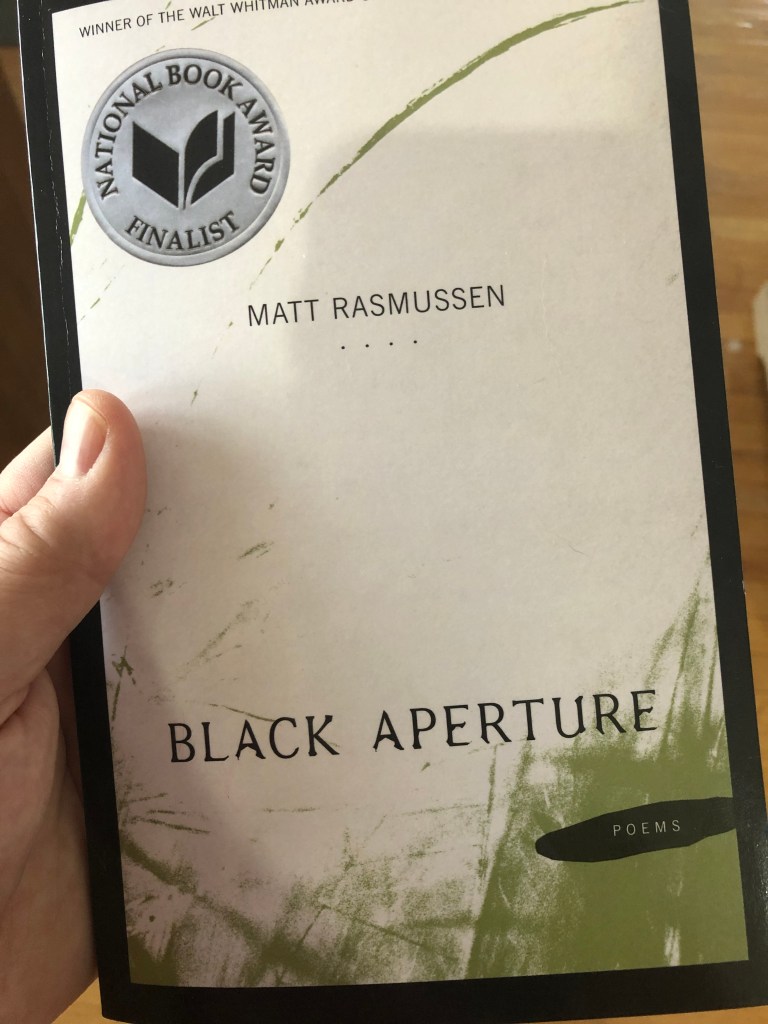
This week, Rhea and I had an opportunity to attend the Possibilities: Heginbotham Literary Lecture Series* at Concordia University, St. Paul, MN. I was grateful to visit my alma mater, chat with professors who have become friends, including Dr. Heginbotham, and see students, faculty, and others come together to hear poetry and perspective. This week, Matt Rasmussen read from and spoke about his book of poetry, “Black Aperture,” which had won him the Walt Whitman Award of the Academy of American Poets and a finalist for the National Book Award. As part of this lecture series, he joins the likes of Louise Erdrich and Garrison Keillor
We were not disappointed.
Here’s my take on what Rasmussen provided to us…hopefully, doing him justice. Of course, as with poetry or any other art from, it’s simply one person’s view…today. I’ll stay high level and try to avoid spoilers. Get the book.**
There are two definitions of aperture. First, it’s simply a fancy word for an opening or a hole. Rasmussen seems to contemplate this idea of negative space – and the positive space around a/the hole, or aperture – and the relationship between the two, and the impact on our thinking. I don’t know if I’ll look at a hole the same way. As he explores the loss of a loved one, the hole – literally and figuratively – that is left, and the space around that hole, is an unending journey. Each year, each holiday, each memory – the hole (which is both negative and positive space) takes on additional meaning.
If the first definition is about the “what,” then the second definition, in terms of photography, takes on the “how.” A camera’s aperture is the opening in a lens that controls the amount of light that passes through the lens and into your photo. It can make the picture darker or lighter and can create depth to make something stand out or to expose a whole landscape.
Whether Rasmussen had the intention of these two definitions, that’s where I landed in terms of the power given not only to his poetry that reflects on such a gut-wrenching life experience, but he gives definition to the very spirit of poetry. Light, dark, deep, shallow, detail, blur – all the nuances that can play into the same picture just by adjusting the aperture whole exploring the negative and positive spaces of an idea.
Even his writing style reflects this idea of playing with both the negative and positive spaces. Ideas bridge between stanzas so that ideas take shape over more than one stanza, or shift the meaning as parts of an idea are merged with other ideas. I found it enjoyable to pause and let the sometimes jarring nature of it to let my mind explore.
That is the joy of reading this book of poetic reflection. It’s an expression of the swath of feelings and thoughts – logical to absurd – one has when faced with the death of a loved one, especially from suicide. The joy comes from seeing the rawness of an individual on paper, and to connect to it in some way.
This is a collection I will pick up again to enjoy the flow – and disruption – within a grieving process…and we know the grieving process is unending. As I took from Rasmussen’s commentary during the lecture, grief isn’t an illness to get rid of as quickly as possible or hide – it’s something to acknowledge, claim, and use as fuel to move forward with new perspective.
Below, is a recording of his lecture, and here is a link to his website. Enjoy!
Also, if you or someone you know is contemplating suicide, please visit https://988lifeline.org/ or simply dial 988.
* Presented by CSP’s Department of English and Modern Languages and the St. Paul Pioneer Press, the Heginbotham Literary Lecture Series is made possible by private donors who established an endowment to honor Dr. Eleanor Heginbotham and her distinguished record of teaching and scholarship at Concordia University as well as her many contributions to the literary community in the Twin Cities.
** I found “Black Aperture” available through LSU Publishing or Amazon.
 a tilting of air